.svg)
.svg)






Disclaimer: The information in this article is for general educational purposes only and does not constitute personalised medical advice. The conceptual models discussed represent pragmatic clinical observations used in practice to address modern lifestyle and technological factors. Always consult your qualified healthcare professional or your General Practitioner regarding your individual care, diagnosis, or treatment plan.
The Courage to Seek Professional Support
If you are currently considering reaching out for professional mental health support for the very first time, let us acknowledge something right away: taking that initial step requires a tremendous amount of courage.
For many adults, the decision to seek help only comes after months, or even years, of quiet, invisible exhaustion. You might be silently struggling with your focus, battling unpredictable energy levels, or simply feeling entirely overwhelmed by the sheer volume of demands in your daily life. Yet, despite the weight of these challenges, people often delay seeking professional guidance because they hold a very specific, slightly intimidating picture in their minds of what psychiatry actually looks like.
Beyond the Traditional Consultation
You might picture a brief, sterile consultation. You might imagine a quick diagnostic label, being handed a prescription, and being swiftly sent back out into the world. If you are navigating complex challenges—perhaps suspecting unrecognised neurodivergent traits like ADHD or autism, or simply feeling crushed by the velocity of the modern world—you probably know instinctively that clinical management alone is not going to fix the complex reality of your life.
There is a persistent, historical misconception that a psychiatrist’s only job is to manage psychological symptoms strictly through the lens of biology and medication. But true, comprehensive, and compassionate psychiatric care has to go much deeper. It has to view you as a whole, dynamic person, navigating an increasingly complicated environment.
Watch Dr Stefan Ivantu explain the transition from traditional care to the 4D-BPS framework in the video below, or continue reading for a comprehensive breakdown.
The Pace of Innovation vs. The Pace of Medicine
To provide truly effective psychiatric care in the 21st century, clinical practice must reconcile the deliberate, rigorous pace of medical science with the unprecedented speed of modern technological change.
The Foundational Medical Model
For decades, the undisputed gold standard in medical and psychiatric education has been the Biopsychosocial Model. It was revolutionary when it first emerged in the late 1970s. It argued that to understand and treat a patient properly, doctors had to look at their biology (genetics, biochemistry), their psychology (mood, personality, behaviour), and their physical social environment (family dynamics, culture, financial realities).
This traditional three-part framework moved medicine away from treating the human body like a broken machine to be fixed in isolation, bringing a much-needed layer of humanity back into the clinic. It remains a foundational truth in modern medicine.
The Acceleration of Modern Life
But as researchers and clinicians advocate for a revitalised approach to this core theory, we must look honestly at the world we live in right now, and the world we will inhabit for decades to come.
We are navigating an era of exponential technological acceleration that is fundamentally altering how our brains operate. Our attention is fractured, the boundaries between work and rest have entirely dissolved, and the raw volume of data entering our consciousness daily is unprecedented in human history.
Agile Frameworks for Current Realities
This presents a very real, practical challenge in the medical field. Academic research and rigorous, peer-reviewed clinical trials are the absolute bedrock of patient safety. But they are inherently, necessarily slow. It can take a decade or more for longitudinal studies to formally validate exactly how a specific shift in our technological infrastructure impacts our dopamine pathways or alters our sleep architecture.
Technology and information systems, however, reinvent our environment in a matter of months.
As clinicians working on the front lines of mental health, we cannot ask patients to wait a generation for an academic consensus on why their synthetic environments are affecting their focus or inducing anxiety. The distress is happening right now, in the consultation room, today. Therefore, while we always ground our medical treatments in rigorous clinical evidence, our frameworks for understanding a patient's life must be agile enough to keep pace with the reality of the rapid changing modern world.

Enter the 4D-BPS Framework
Let us be entirely clear: what we call the 4-Dimensional Biopsychosocial (4D-BPS) Framework is not a peer-reviewed academic breakthrough. It isn't a rigid new diagnostic manual.
Rather, it is a pragmatic clinical concept.
It is a practical working lens born out of absolute necessity. It acknowledges a simple clinical reality: we no longer inhabit an environment that is strictly physical or social. We now live alongside a deeply embedded 'fourth dimension'—our Informational & Technological Reality.
By formally integrating this fourth pillar into how we assess and support patients, we create a roadmap that actually matches the world you live in today, and the world you will navigate tomorrow. We have to treat what is sitting in front of us today, using a model that anticipates where human experience is heading.
Let’s break down exactly what each of these four dimensions means in practice, and why addressing them together is the key to sustainable well-being.
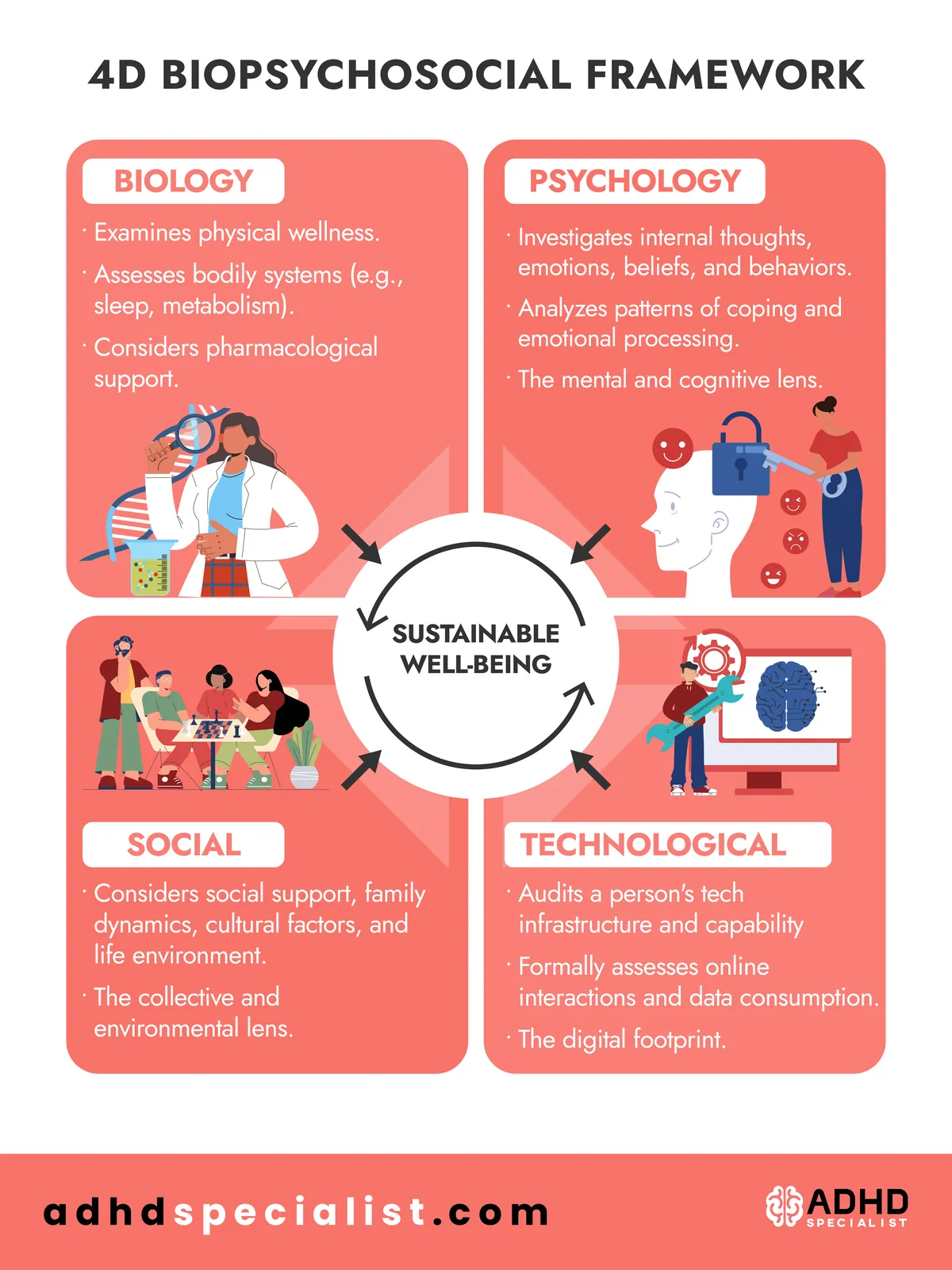
1) The Biological Foundation (Mind, Body, & Metabolism)
Everything starts with the foundational pillar: biology.
When someone first sits down for an assessment, whether in a physical clinic or online, they are very often exhausted. They have spent all their cognitive reserves just trying to hold things together at work or at home. Challenges with executive function (the brain's management system for planning, organising, and starting tasks)—and the overwhelming friction of what we call ADHD Gravity Debt—are deeply rooted in our neurobiology.
The Role of Clinical Interventions
Because of this physical reality, clinical and pharmacological options can be incredibly helpful. For many individuals, medication is a vital first step to turn down the internal 'noise' in the brain and find a baseline of stability.
But if you are reading this and feeling hesitant about medication, your concerns are completely valid. A clinical intervention is a tool, not a cure-all. A pill does not build life skills. It won't teach you how to organise your day, it won't set boundaries with a demanding career, and it won't resolve deeply held emotional trauma. It provides the initial stability, but as we frequently see when long-held coping mechanisms and external scaffolding eventually collapse, you still have to build the house yourself.
Optimising the Physical Engine
More importantly, biology within this framework is much broader than a prescription pad. Your brain is a highly demanding physical organ, intimately connected to the rest of your body. We have to look at the physical engine driving it:
- Metabolic Health: Are there underlying thyroid issues, hormonal imbalances, or vitamin deficiencies masquerading as low mood or psychiatric symptoms? We cannot treat the mind while ignoring the body’s chemistry.
- Sleep Architecture: We intentionally use the word architecture, not just duration. It is not merely about achieving eight hours of unconsciousness. Are you getting the restorative deep sleep required for physical repair? Are you reaching the REM (Rapid Eye Movement) cycles needed to process emotional stress? Chronic sleep fragmentation is one of the most potent triggers for poor executive function. Treating psychiatric symptoms without addressing adult sleep problems is like trying to bail water out of a boat with a hole in the hull.
- Nutritional Psychiatry: Modern biological care must encompass what you consume. The food you eat directly impacts your gut microbiome—the trillions of bacteria in your digestive tract. This microbiome is in constant communication with your brain via the vagus nerve. Diets high in ultra-processed foods drive systemic inflammation, which is clinically observed to be linked to depression, brain fog, and chronic fatigue.
Your physical foundation has to be secure before we attempt to build complex psychological strategies on top of it.
.webp)
2) The Psychological Narrative (Understaning the Mind)
Once the physical engine is stable, we move to the second dimension: the Psychological.
This is where we turn our attention to the mind itself. We look at the internal landscape of your thoughts, your coping mechanisms, and your emotional history. If you have navigated life for decades without speaking to a professional, opening up this pillar can feel daunting, but it is also deeply liberating.
We ask the hard questions: How do you process acute and chronic stress? What is the internal narrative running in your head all day?
Addressing the Inner Critic
Many adults arrive at a psychiatric clinic carrying a heavy burden of secondary distress. They might be struggling with severe impostor syndrome or a remarkably harsh inner critic that constantly monitors their behaviour. This critic is rarely an inherent part of their personality. It is usually a defensive mechanism, developed in response to a world that felt overwhelming or invalidating.
This is particularly common for people who have lived with unrecognised neurodivergent traits for most of their lives. When your nervous system processes information differently from the societal norm, you spend your formative years receiving subtle, or overt, messages that your natural way of being is 'wrong', 'lazy', or 'too much'.
The Cognitive Toll of Compensatory Strategies
To survive socially and professionally, many individuals learn to 'mask'—consciously suppressing natural behaviours and forcing themselves to mimic neurotypical standards of focus and communication. Masking can be an effective short-term survival strategy. But keeping the mask on every day for decades requires an unsustainable amount of cognitive energy. Eventually, this leads to profound burnout, presenting clinically as severe depression, chronic fatigue, or debilitating anxiety.
Our role in this psychological pillar isn't to judge that coping mechanism. It is to help you safely navigate it. We work collaboratively to identify and gently dismantle the negative self-beliefs that have built up over years of untreated struggles. We separate who you are from what you’ve been struggling to manage. The ultimate goal is to reframe how you view your own mind—moving away from a paradigm of self-blame and rigid perfectionism, and towards genuine, sustainable self-compassion.
.webp)
3) The Traditional Social Environment (Your Physical Ecosystem)
With the biological engine addressed and the internal narrative understood, we look outward to the third dimension: the Traditional Social Environment.
None of us exist in a vacuum. For most of human history, our social environment simply meant our physical, tangible reality. Today, in our framework, this pillar represents your immediate physical ecosystem. It includes your family dynamics, the pressure of major life transitions—often experienced as the executive timeline trap around career or family planning—your financial responsibilities, your physical workspace, and the face-to-face relationships you maintain.
A fundamental clinical truth is that a medical professional can provide the most precise biological and psychological support in the consultation room, but if you return to a physical environment that is fundamentally at odds with how your nervous system functions, you will continue to experience severe friction.
The Art of Self-Advocacy
Part of taking that brave first step into comprehensive care is learning the art of self-advocacy in the real world. Many individuals who struggle with chronic stress or executive dysfunction are perpetual people-pleasers, chronically prioritising the comfort of others over their own basic needs.
Within this social pillar, we explore how to communicate your needs clearly, confidently, and without unwarranted guilt. It is about learning to articulate your boundaries. This might mean:
- Explaining to a partner why you need a strict hour of quiet decompression time after work to regulate your nervous system.
- Communicating to a manager about the specific communication style that helps you execute tasks most efficiently.
- Adjusting your physical workspace. If open-plan office noise shatters your concentration, or fluorescent lights trigger sensory overload, we look at how to modify that space.
By addressing the physical and social environment, we ensure that your external reality actively supports your recovery and daily functioning, rather than constantly fighting against it.
.webp)
4) The Informational & Technological Reality (The Extended Ecosystem)
If we stop at the traditional three pillars, we miss the defining shifts of the 21st century. This brings us to the final, critical fourth dimension: our Informational Reality.
Neurobiology in a Synthetic Environment
As clinicians, we observe every day that the human environment is no longer strictly physical or analog. We are interacting with synthetic environments, automated data streams, and highly sophisticated information architectures explicitly designed to capture, hold, and monetise human cognitive attention in what is essentially a trillion-dollar attention economy.
For any human mind, this landscape is demanding. But for a sensitive nervous system, or a mind already struggling with executive dysfunction, this constant influx of synthetic stimuli is profoundly overwhelming. Recent neurobiological reviews highlight that AI-driven algorithms deliberately induce neurophysiological reward loops, deeply over-activating reward pathways while simultaneously altering activity patterns within the prefrontal cortex and amygdala. The clinical result is heightened emotional vulnerability and compromised executive control.
The human brain simply did not evolve to process the emotional weight of global crises, the curated highlight reels of thousands of peers, and the incessant pinging of professional obligations simultaneously. Acknowledging this real-time impact on human neurobiology is non-negotiable.
The Paradox of Quantified Health
We also see this play out in how we attempt to track and quantify our own health. It is completely normal now to utilise devices to monitor our sleep architecture, daily step counts, and heart rate variability.
While baseline awareness is generally a positive starting point, we frequently observe the darker side of this phenomenon: individuals developing heightened, severe health anxiety purely because of their tracking metrics. This occurs when a system gives a person an out-of-context 'score' for the day. Waking up feeling relatively refreshed, only to look at a metric that states your "recovery is low," can immediately trigger an adverse stress response. It makes people feel as though they are actively failing at their own biology. Data without clinical context is not medical care; it is often just a new source of stress.
Maintaining Cognitive Autonomy
Crucially, as we look to the future, this dimension will only expand. Whether we are interacting with interfaces on screens, immersive spatial computing, or automated systems, the core therapeutic challenge remains the same: how do we maintain cognitive autonomy in a world saturated with external data?
The goal when addressing this informational pillar is not avoidance or an unrealistic disconnect from the modern world. That is entirely incompatible with maintaining a modern livelihood. Instead, managing this dimension involves helping you create robust, sustainable boundaries with your technological ecosystem. It is about practising deliberate cognitive and digital hygiene—ensuring that your information architecture serves your life, rather than constantly depleting your energy and fracturing your peace of mind.
.webp)
The Core Philosophy: Human Empathy vs. Artificial Systems
Understanding this complete, 4-Dimensional framework brings us to a deeply important point about the future of mental health care, and crucially, why reaching out to a human professional remains irreplaceable over the longer term.
In a world increasingly enamoured with automated systems and digital therapeutics, we are frequently asked: As algorithms continue to advance, will automated systems eventually replace the need to see a human psychiatrist?
Structural Design and Purpose
Digital tools and automated psychological therapy applications can be wonderful, accessible additions to a healthy lifestyle. They are transitionally useful for processing data and delivering standardised information. But when you are taking the brave, vulnerable step to seek care for your mind, we must recognise a fundamental difference in purpose and reality between an automated system and a medical doctor.
First, look at the structural design of the tool. A digital platform or an automated algorithm is inherently designed for ongoing interaction. Its success metrics are frequently based on keeping you engaged within the system.
The Unbridgeable Gap of Lived Experience
There is also a profound, unbridgeable difference between a system processing language data and a human being experiencing life.
No matter how sophisticated technology becomes, an algorithm does not possess the lived experience of being human. It is not biological. It does not possess an organic nervous system. It does not know what it feels like to be exhausted to the bone. It has never grieved a loss. It does not know the visceral reality of physical pain, the sting of social rejection, or the overwhelming complexity of simply trying to exist and find meaning in the world.
The Therapeutic Alliance
Genuine psychiatric care, the kind that fosters deep, lasting change, requires what we call in medicine the 'therapeutic alliance'. Sometimes, to truly help someone break through a lifelong barrier of shame or fear, we have to engage in a deeply empathetic, shared human conversation.
Clinical skills are the product of rigorous medical education, evidence-based research, and constant professional development. But in practice, those skills are delivered through a fundamental, biological human bond. As humans, we possess mirror neurons; we regulate each other's nervous systems through eye contact, vocal tone, and genuine presence. In mental health, while data can inform the treatment, a shared, authentic human connection is where true healing begins.

Taking the First Step
If you choose to seek help, remember that a modern clinic using the 4D-BPS Framework does not just treat a label or suppress a symptom. We address the biological realities that drive your engine. We explore the psychological narratives that shape your self-worth. We examine the traditional physical world that surrounds you. And we help you navigate the modern informational landscape that constantly demands your attention.
If you have been holding back from seeking professional help because you feared a cold, clinical approach, the philosophy behind our clinic demonstrates that modern care has evolved to meet the challenges of our time. It is not about quick fixes, reductionist labels, or dismissing your complex reality. It is about understanding your entire, unique ecosystem and giving you the tools to thrive within it.
References
The Luxury of Focus: ADHD in a Trillion-Dollar Economy
The need for a new medical model: a challenge for biomedicine - PubMed
Biopsychosocial Model in Contemporary Psychiatry: Current Validity and Future Prospects - PMC
The Gravity Debt: Maslow’s Hierarchy in the Modern Economy
The ADHD Scaffolding Collapse: Why High-Achievers Crash
Adult ADHD & Sleep Problems Treatment London | ADHD Specialist
Adult ADHD & Anxiety Treatment London | ADHD Specialist
Adult ADHD & Fertility: The Executive Timeline Trap
Why Choose ADHD Specialist? | Expert ADHD Care in London & UK
Our Story: Psychiatry Beyond the Prescription | ADHD Specialist
Disclaimer: This blog is for educational and general information purposes only and does not constitute medical advice, diagnosis, or treatment. The content is not intended nor implied to be a substitute for professional consultation with your own doctor or qualified healthcare professional. Diagnosis and treatment should always be conducted under the supervision of a qualified medical professional. Information about mental health topics and treatments can change rapidly, and we cannot guarantee the content's currentness. For more information, you can check the Royal College of Psychiatrists (rcpsych.ac.uk).
Image Credits: Pexels.com and Shutterstock.com.





.svg)


