.svg)
.svg)






In the quiet corners of high-end audio listening rooms in Mayfair, or the specialised photography boutiques of Central London, a curious trend is emerging. It is not a trend driven by nostalgia, nor is it a rejection of the future. It is a strategic retreat into the tangible.
We are seeing executives, creatives, and entrepreneurs—individuals whose careers are built on speed and connectivity—paying a premium for slowness. They are investing in cameras without screens, turntables that require manual calibration, and sports cars that have removed the automatic gearbox in favour of a mechanical stick shift.

Why? Because in an economy that mines human attention for profit, focus has become the ultimate luxury good.
For the high-functioning professional with ADHD, this is not merely a lifestyle aesthetic. It is a neurological necessity. If you have spent your life feeling that your brain is a high-performance engine with bicycle brakes, you understand the need for control. The digital world promises efficiency, but for the neurodivergent mind, it often delivers a cage—one gilded with notifications and infinite scroll, but a cage nonetheless.
In this article, we will explore why the "Analog Life" is a critical component in managing the modern ADHD brain. We will look beyond the diagnosis and the medication to the ecosystem you inhabit. We will break down the mathematics of the Trillion-Dollar Attention Economy, the dopamine traps of the algorithm, and why reclaiming your physical reality might be the most effective "scaffolding" you can build for your mental health.

The Trillion-Dollar Extraction
To understand why you feel exhausted, scattered, and perpetually "behind" despite your success, we must first look at the scale of the forces competing for your mind.
We often hear about "Tech Giants" and "Trillion Dollar Companies." These terms are thrown around in the financial press so casually that they have lost their weight. The human brain is not evolved to comprehend numbers of this magnitude. We understand a herd of 50 deer; we struggle to visualise a billion.
Let’s pause and do the maths.
What is a trillion? It is one thousand billions. What is a billion? It is one thousand millions.
To put this into a timeframe that the ADHD brain—which often struggles with "time blindness"—can understand:
- 1 Million seconds is roughly 11 and a half days.
- 1 Billion seconds is roughly 31 and a half years.
- 1 Trillion seconds is 31,709 years.
When we say a company is worth four trillion dollars, or that an algorithm processes billions of data points, we are talking about a scale of resources, computing power, and behavioral psychology that is, frankly, incomprehensible.
These companies employ the brightest minds in neuroscience, psychology, and data science with a singular goal: Retention. Their business model is not to provide you with a tool; it is to extract your time. You are not the customer; your attention is the product, and advertisers are the buyers.

The Algorithm vs. The Hunter-Gatherer
Now, consider your biology. If you have ADHD, your brain is likely wired with what we might call "Hunter-Gatherer" genetics. You are evolutionarily designed for:
- High alertness: Noticing subtle changes in the environment.
- Rapid switching: Moving attention quickly from one stimulus to another to ensure survival.
- Dopamine-seeking: A drive to explore, to hunt, to find the "new" resource.
For thousands of years, this was a superpower. It kept the tribe alive.
Today, you are taking that hunter-gatherer brain—which craves novelty and reward—and placing it inside a digital ecosystem designed specifically to exploit those exact traits.
The algorithm is a "Super-Stimulus." It provides a hit of dopamine that is faster, more frequent, and more intense than anything found in nature. A walk in the woods cannot compete with the algorithmic feed. Reading a book cannot compete with 15-second video clips tailored to your specific anxieties and interests.
You are not "weak" for getting stuck scrolling on your phone until 2 AM. You are not "lazy" for failing to prioritise your emails over a social media loop. You are simply bringing a slingshot to a nuclear gunfight.

The Mathematics of Your Life
In my practice, I often work with successful individuals who feel they have "no time." As discussed in our article on ADHD & High-Achievers in London, these are often people who are asset-rich but "time-poor," watching their life slip through their fingers like sand.
Let us perform a forensic audit of a standard human day. We all have the same bank account of time: 24 Hours.
- Biological Necessity: You must sleep. However, for the neurodivergent brain, sleep is rarely simple. As I discussed in my article on The ADHD Sleep Burnout Triangle, many professionals are stuck in a cycle of "Bedtime Procrastination," sacrificing sleep to regain a sense of control. Let’s assume a target of 8 hours.
- Maintenance: Washing, eating, dressing, basic hygiene. Let’s allocate 2 hours.
- The Work Contract: Most professionals are engaged in work for at least 8 hours (often more for high-achievers).
- Logistics: Commuting, school runs, travel. 1 to 2 hours.
Let’s do the subtraction: 24(one day)- 8(sleep)- 2(maintenance) - 8(work) - 2(logistics) = 4 Hours.
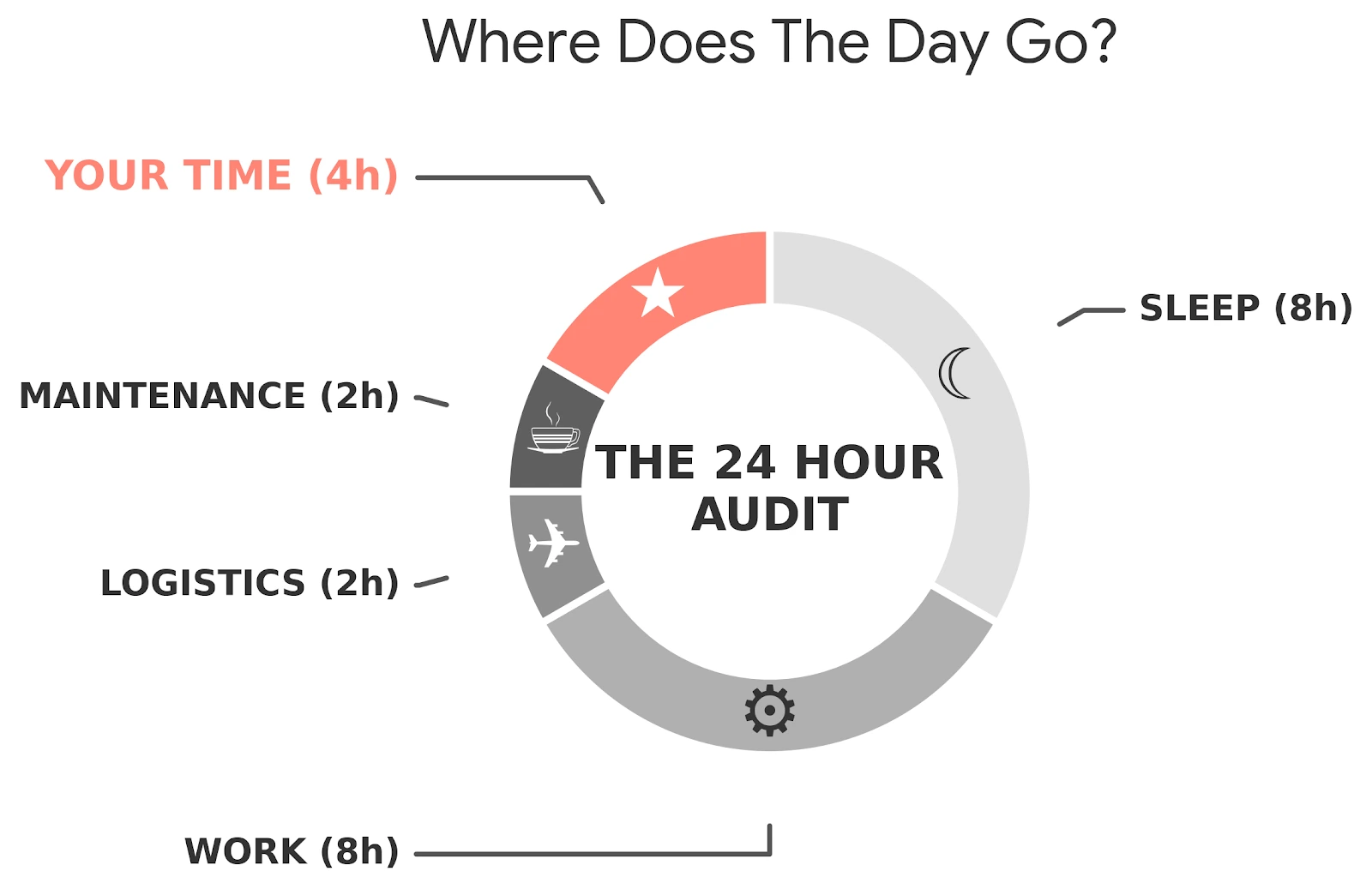
You are left with perhaps 4 hours of "Discretionary Time." This is the only time you have to be a human being. This is the only time available to invest in your partner, as detailed in our guide on How ADHD Affects Relationships. It is the only time for your children, your hobbies, and your dreams.
When you give those remaining 4 hours to the algorithm, the cost isn't just "wasted time"—it is bankruptcy of the self.
The Screen Time Tax
Now, look at your phone’s "Screen Time" report.
The average adult spends between 4 to 6 hours a day on their mobile device. If your screen time is 4 hours, and your discretionary time is 4 hours, you have effectively zeroed out your life. You have spent your entire "free" existence inside the algorithm.
This phenomenon is what we clinically refer to as "displacement"—where digital consumption crowds out essential life activities. For a deeper clinical perspective on this, I recommend reading our guide on ADHD and Phone Addiction, which explains the neurology of why it is so hard to just "put the phone down."
This is why the "Analog Life" is not a hipster affectation; it is a reclamation of existence.
If you can reduce your screen time from 5 hours a day to 3 hours a day, you have reclaimed 2 hours. Over a week, that is 14 hours. That is practically two full working days, or one long waking day, added to your life every single week.

The Premium of Friction (Why Less Costs More)
In the luxury market, we are seeing a fascinating inversion. Historically, technology was sold on the promise of convenience and automation. We paid more for things to be easier.
Today, the most exclusive products are those that reintroduce Friction.
Consider the automotive industry. A modern, mass-market SUV car is a computer on wheels. It has lane-assist, automatic braking, an automatic gearbox, and massive touchscreens. It drives itself, largely. It requires almost zero cognitive load from the driver.
Now, look at the pinnacle of the sports car market—specifically within the "limited run", "track-focused" or "touring" ranges of high-end manufacturers. On the used market, we are seeing a distinct trend where the manual versions command significantly higher prices than their automatic counterparts. And what are you paying for?
- You are paying for the Manual Gearbox.
- You are paying for less sound insulation (to hear the engine).
- You are paying for analog dials rather than digital displays.
Why would a CEO pay a premium to do more work while driving?
Because the manual gear change requires physical engagement. It demands that you are present in the moment. You cannot doom-scroll while driving a manual car at speed. The "friction" of the clutch and the gear stick grounds the driver in reality.
It forces a "Flow State"—the holy grail for the ADHD mind.
This is not a fringe theory; it is a measurable cultural shift. As reported by Fortune, generations from Gen Z to Baby Boomers are increasingly creating "Analog Islands." Whether it is returning to vinyl records, board games, or stick shifts, people are consciously choosing these disconnected sanctuaries to insulate themselves from the digital flood.
.webp)
The Rangefinder Effect: Photography Without a Screen
We see the same phenomenon in photography. Digital cameras are miracles of technology. You can take 10,000 photos, review them instantly on a screen, and delete the bad ones.
Yet, certain heritage brands have released high-end models that are fully digital but have no rear LCD screen.
To the uninitiated, this seems insane. Why pay a fortune for a digital camera that doesn't let you see the photo?
For the ADHD enthusiast, it is a revelation.
- No Chimping: "Chimping" is the habit of looking at the screen immediately after every shot. It breaks the flow. It takes you out of the moment. Without a screen, you must trust your skill. You stay in the scene.
- Delayed Gratification: You only see your images when you get home. This rebuilds the dopamine pathways that have been eroded by instant gratification.
- Tactility: The focus is manual. The aperture is a physical ring. The shutter is a mechanical click.
This is Tactile Grounding. For a brain that feels like it is floating in a cloud of anxiety and abstract data, the cold brass of a lens or the mechanical click of a shutter provides a physical anchor.
Note: While investing in quality tools can be beneficial, the ADHD brain is prone to impulse buying. If you find yourself acquiring gear you don't use, I urge you to read our insights on ADHD Overspending and Impulsivity to ensure your hobby remains a passion, not a financial burden.

The Audiophile Ritual
Music streaming is the ultimate convenience. Access to 100 million songs instantly. But for the ADHD brain, this "infinite choice" leads to paralysis. We skip a track after 30 seconds because the dopamine hit wasn't high enough. We treat music as background noise.
Enter the revival of High-Fidelity Vinyl.
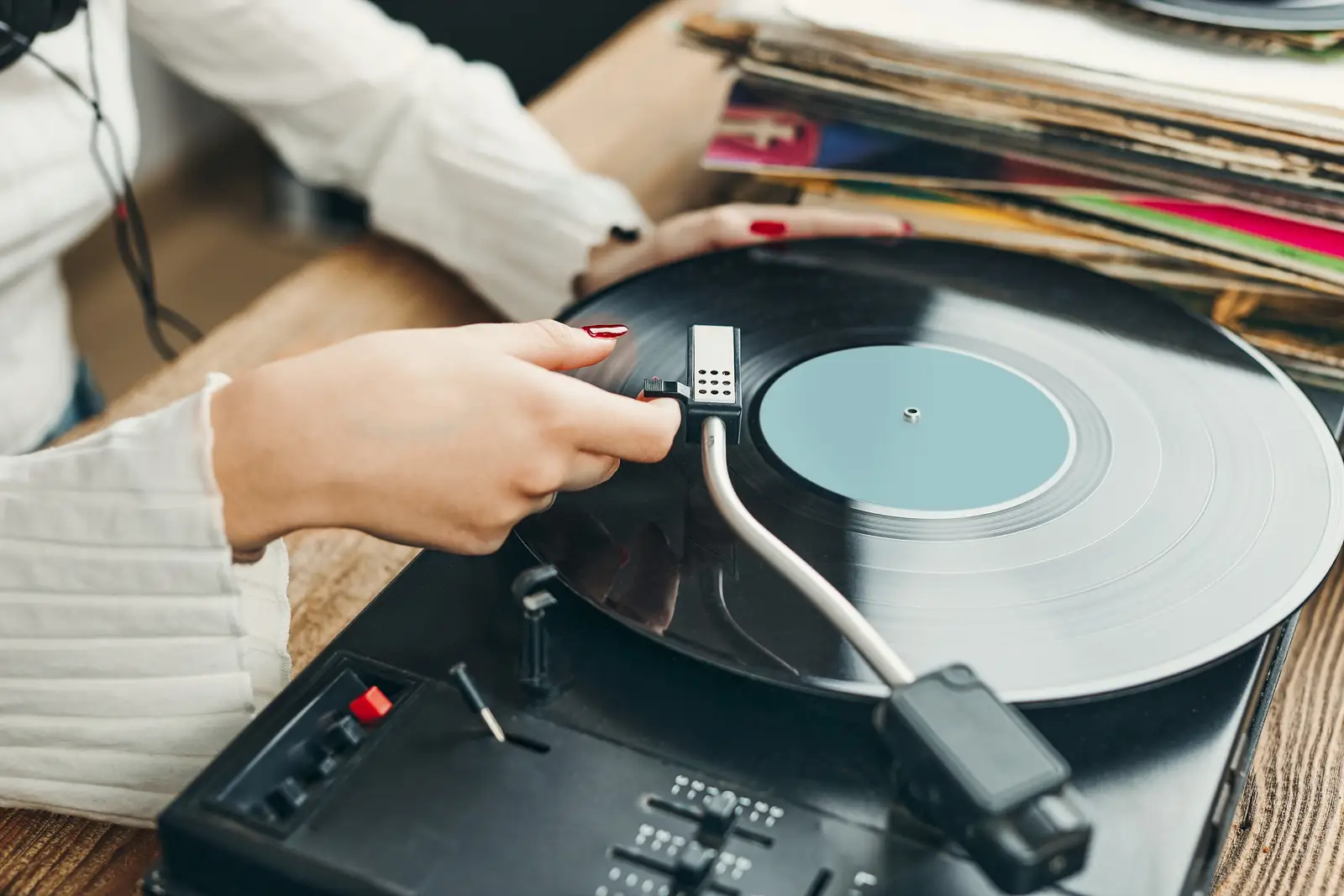
A vinyl record is inconvenient. You have to take it out of the sleeve. You have to clean it. You have to drop the needle. You have to flip it after 20 minutes.
This ritual is the therapy.
- Active Listening: You cannot skip a track easily. You are forced to listen to the "deep cuts," the slow songs, the builder tracks. You learn patience.
- The Sound: Analog sound (especially via valve/tube amplifiers) is often described as "warmer." But more importantly, it is a continuous wave, not a sampled binary file.
- Fixability: If a turntable belt breaks, you can replace it. If a valve burns out, you change it. These objects are understandable.
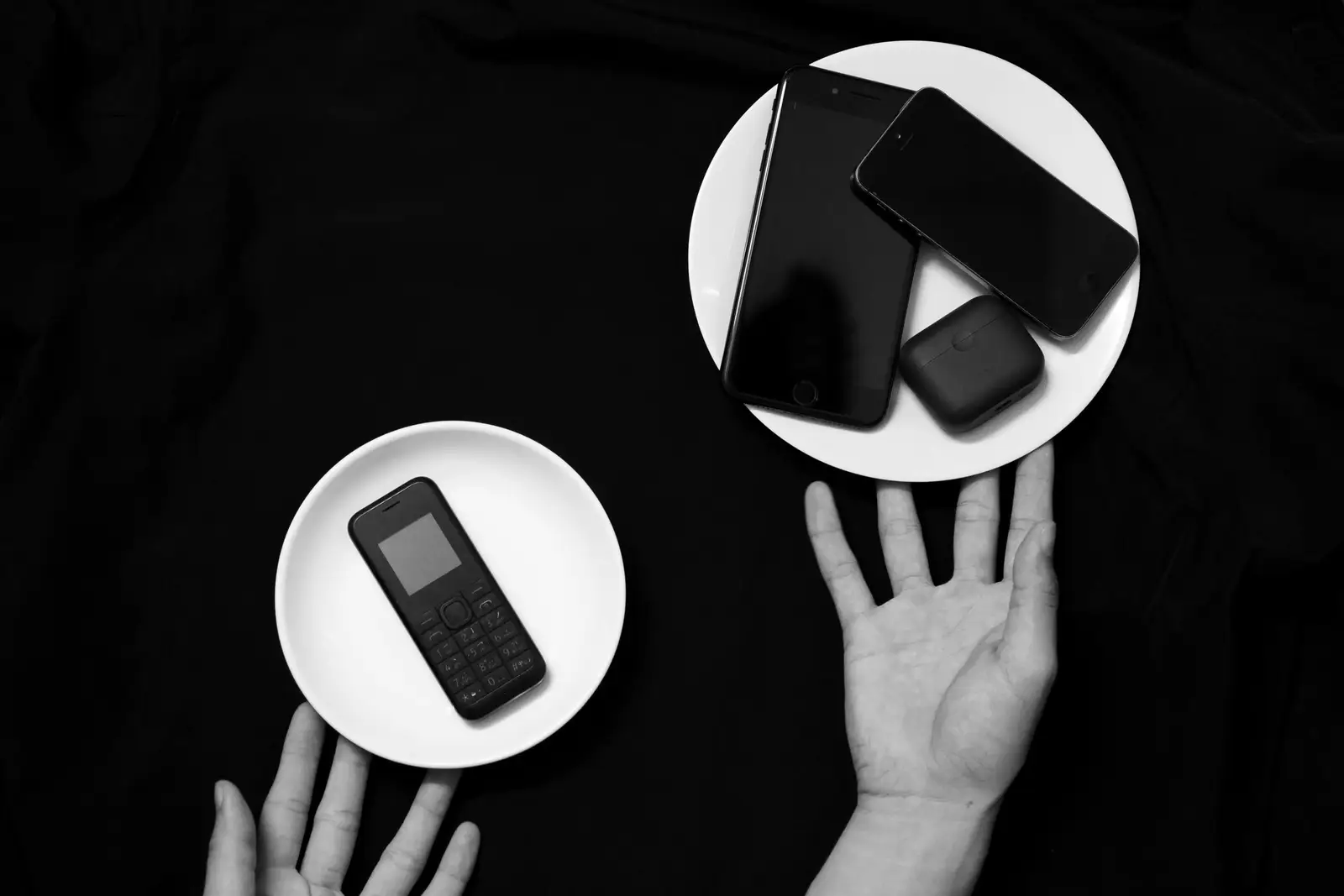
Compare this to a smartphone. If it breaks, it is a sealed black box. You cannot fix it; you must replace it. This contributes to a sense of learned helplessness. Living with analog objects that can be maintained and repaired gives us a sense of agency and permanence in a disposable world.
Privacy and the "Un-Trackable" Self
There is another aspect to the analog life that appeals to the privacy-conscious individual: Silence.
We live in an era of surveillance capitalism. Your smart TV watches what you watch. Your phone tracks where you go. Your interactions are data points used to predict your behavior and sell it to the highest bidder.
An analog camera does not have GPS. A vinyl record does not report to a server how many times you listened to "Dark Side of the Moon." A mechanical watch does not track your heart rate or sell your sleep data to an insurance company.
For the ADHD mind, which is often prone to anxiety about "being observed" or "judged" (a component of Rejection Sensitive Dysphoria), analog objects offer a safe harbour. They serve you, they do not study you.
There is a profound mental quietness in using a device that is "dumb." It does one thing, and it does it perfectly, without asking for your data in return.

Sustainability, Not Luddism
I want to be very clear: I am not suggesting you move to a cave and throw away your mobile phone.
We are modern professionals. We need email. We need WhatsApp. We need GPS. To reject digital technology entirely is not a sustainable strategy; it is a form of denial.
At my practice, we do not preach "Digital Detoxes." Why? because detoxes imply a temporary state. You starve yourself of tech for a week, and then you binge when you return. That is the "yo-yo dieting" of the attention economy.
Instead, we advocate for Digital Nutrition and Analog Integration.
This is about building a robust structure for your life. In my previous writing on ADHD Scaffolding Collapse, I explained how vital external structures are for the ADHD brain. Analog habits are the strongest "pillars" you can add to that scaffolding because they are physical, visible, and cannot be swiped away.
The "Hybrid" Routine
How does this look in practice for a patient with ADHD?
- The Digital Workstation, The Analog Home: Keep the high-speed, multi-screen setup for the office. But make the bedroom and the living room "low-tech" zones. Buy a physical alarm clock so your phone does not need to be by your bed (breaking the sleep-burnout cycle).
- Manual Hobbies: Engage in hobbies that require fine motor skills. Manual photography, watchmaking, cooking from scratch, gardening, playing an acoustic instrument. These activities engage the "Default Mode Network" of the brain in a healthy way, allowing for processing and decompression.
- Paper Thinking: When you are overwhelmed, do not open a productivity app. Take a fountain pen and a high-quality notebook. The friction of the pen on paper slows down your thinking. It forces you to linearise your chaotic thoughts. You cannot "copy-paste" in a notebook; you have to commit to the sentence. This is cognitive training.
- Single-Tasking Zones: Create spaces where only one thing happens. A listening chair where you only listen to music. A reading nook with no screens allowed.

Why We Focus on Lifestyle, Not Just Labels
In the UK medical system, and specifically within psychiatry, there is often a rush to label and medicate. You fill out a form, you get a score, you get a pill.
While medication is a vital, life-changing tool for many (and remains the first line of treatment in clinical guidelines for significant impairment), it is not a panacea. Medication regulates the neurotransmitters, but it does not change the environment.
You cannot medicate your way out of a bad ecosystem.
If you take stimulants to improve your focus, but you then point that enhanced focus at a social media algorithm designed to entrap you, you will simply become more efficiently distracted. You will doom-scroll with greater intensity.
This is why, at ADHD Specialist, we take a holistic, consultant-led approach. We treat the person, not the symptom checklist.
When we assess a patient—whether they are a CEO in the City, a creative director in Shoreditch, or a student at a top university—we look at the "Architecture" of their life.
- We analyse your routine.
- We discuss your digital consumption and Career Burnout risks.
- We look at your sleep hygiene.
- We understand your sensory needs (are you seeking dopamine, or are you overwhelmed by noise?).
We are not saying that digital devices are "demons." We are saying that they are powerful tools that require a safety manual, especially for the neurodivergent brain. We want you to be the pilot, not the passenger.

Moving from "Consumer" to "Creator"
The ultimate goal of the analog shift is to move you from a state of passive consumption to active creation.
The algorithm wants you to consume. It wants you to watch the video of someone else building a table, someone else taking a photo, someone else living a life. The analog life demands that you build the table. You take the photo. You drop the needle on the record.
For the ADHD brain, which is naturally creative and innovative, this shift is transformative. It turns the "restlessness" of hyperactivity into the "flow" of creation.

Conclusion: Reclaiming Your Agency
If you are reading this, perhaps you are realising that your "brain fog" is not just about biology, but also about the relentless cognitive load of the Trillion-Dollar Attention Economy. You may have the trappings of success—the career, the house, the status—but you lack the luxury of a quiet mind.
You are not alone. And more importantly, you are not broken. You are simply a hunter-gatherer trying to survive in a data mine.
If you are living in London, or elsewhere in the UK, and you feel that you are stuck in this cycle—seeking dopamine from sources that leave you empty, feeling controlled by your devices, or struggling to maintain the scaffolding of your life—it may be time for a professional conversation.
We invite you to book a comprehensive ADHD assessment. But expect more than just a tick-box exercise. Expect a deep dive into your neurology, your lifestyle, and your potential. Let us help you build a sustainability plan that integrates the best of modern medicine with the timeless wisdom of the analog world.
It is time to stop scrolling and start living.
References:
The ADHD Scaffolding Collapse: Why High-Achievers Crash
ADHD & High-Achievers in London: The Private Path to Success
ADHD Stimulation Cycle: Vaping, Smoking & Endless Scrolling
ADHD Planner That Actually Works | ADHD Specialist
ADHD and Career Burnout: Causes, Signs & Recovery Tips
How to Work from Home with ADHD - 15 Strategies for Success
Private ADHD Assessment London | Adults & Teens (16+) | UK
ADHD & Phone Addiction: 11 Strategies to Reclaim Your Focus
ADHD: Could It Be an Evolutionary Advantage?
ADHD and Entrepreneurship: A Double-Edged Sword
Brown Noise in ADHD - The Sound of Nature | ADHD Specialist
Gen Zers and millennials flock to so-called analog islands | Fortune
2,617 Distractions a Day: Why Your Phone Is Sabotaging Your Focus | by Keng Sheng Chew | Medium
Disclaimer: This blog is for educational and general information purposes only and does not constitute medical advice, diagnosis, or treatment. The content is not intended nor implied to be a substitute for professional consultation with your own doctor or qualified healthcare professional. Diagnosis and treatment should always be conducted under the supervision of a qualified medical professional. Information about mental health topics and treatments can change rapidly, and we cannot guarantee the content's currentness. For more information, you can check the Royal College of Psychiatrists (rcpsych.ac.uk).
Mentions of specific product categories (e.g., manual cars, rangefinder cameras) are for illustrative purposes only to demonstrate lifestyle strategies and do not imply a commercial endorsement or affiliation.
Image Credits: Pexels.com and Shutterstock.com.






.svg)


